- a service designed to promote health;
- any therapeutic or other service designed to cure, alleviate, or afford protection against, any mental or physical illness, abnormality or disability;
- any paramedical or ambulance service;
- the care of, or assistance to, sick or disabled persons at their place of residence; or
- a prescribed service.
- the film will be produced wholly or substantially within South Australia;
- the production of the film will involve or result in the employment of South Australian residents; and
- the production of the film will result in economic benefits to the State of South Australia.
The above list of exempt employers is not exhaustive. If you require confirmation or clarification that your organisation is exempt from payroll tax, please contact RevenueSA.
Applying for an exemption
How do I apply for an exemption?
To apply for an exemption from payroll tax, you must submit an Application (PDF 309KB) and provide:
- your organisation’s Constitution and/or Memorandum and Articles of Association or proof of incorporation under the Associations Incorporation Act, including the organisation’s rules. This must show the organisation’s objectives and non-profit status. All documentation must be signed and dated and should support the date you are requesting the exemption to start;
- a copy of the organisation’s last audited annual report;
- details of the day-to-day activities and services provided by the organisation;
- details of other jurisdictions where wages are paid; and
- any other relevant information in support of your application.
What if the organisation’s circumstances change?
You must tell us anytime there is a change to the organisation’s governing rules, specifically the organisation’s objects and/or non-profit status, to confirm your exemption remains valid. These include the organisation’s:
- Constitution;
- rules;
- memorandum/articles of association; and
- organisation name.
Returns
The 2 types of returns required to be lodged are monthly returns and annual reconciliation returns.Monthly returns
Every employer or deemed employer who is registered or required by the Payroll Tax Act 2009 to apply for registration must, within seven (7) days after the close of each month, lodge with the Commissioner a return together with the tax payable for the required return period. RevenueSA will accept lodgement of returns on the next business day where the 7th falls on a weekend or public holiday. A return must be lodged each month whether or not tax is payable. Failure to do so will result in a default assessment being issued. However, in special circumstances, the Commissioner may extend the time within which returns must be lodged or may authorise the lodging of returns on an annual basis. See the Lodgement Dates section on the Returns and Annual Reconciliation for more details. All monthly lodgements are completed through through RevenueSA Online. The employer is required to calculate the tax payable using RevenueSA Online and send the payment of tax to RevenueSA. The Commissioner may, at any time by notice in writing, require an employer to lodge further or more detailed returns.
Annual reconciliation
Each financial year, all registered employers must lodge an annual reconciliation return. The annual reconciliation gives employers the opportunity to review their tax paid for the financial year, make any necessary adjustments to correct overpayments or underpayments made during the year and confirm a registered employer’s status. Tax for the month of June will be incorporated in the annual reconciliation return. The annual reconciliation should include details of taxable wages, and the various components that make up these wages. Interstate wages (if applicable) are also required. The due date for completion and lodgement of the annual reconciliation return is 28 July. RevenueSA will accept lodgement of returns on the next business day where 28 July falls on a weekend. Completion of the annual reconciliation return is through RevenueSA Online. Information about the annual reconciliation process is sent to registered employers in June each year. If your organisation is part of a group, the Designated Group Employer (DGE) is required to lodge the annual reconciliation first before other group members. This allows the Designated Group Employer (DGE) to distribute any unused deduction entitlement to group member(s). When the group member subsequently lodges, the remaining deduction will be allocated resulting in the correct tax being calculated. Find out more about grouped organisations in our Grouping of employers section. Interest and/or penalty tax Interest may be applied to the late lodgement of an annual reconciliation.
Modifying your annual reconciliation
If needed, an annual reconciliation can be modified if lodged within the last 5 financial years. Annual reconciliations lodged via RevenueSA Online can be modified via RevenueSA Online.
Calculation of payroll tax
Payroll tax is generally payable monthly. The tax payable is calculated using the formula below: (Gross Taxable South Australian Wages - Deduction) x Tax Rate = Payroll Tax Payable This basic formula varies based on group membership and interstate wages.
Tax rates
Current rates
Effective from 1 January 2019
Annual Australian Taxable Payroll: Does not exceed $1.5 million Exceeds $1.5 million but not $1.7 million variable from 0% to 4.95% Exceeds $1.7 millionPrevious rates
1 July 2017 to 31 December 2018
Annual Australian Taxable Payroll: Does not exceed $600,000 Exceeds $600,000 but not $1 million Exceeds $1 million but not $1.5 million variable from 2.5% to 4.95% Exceeds $1.5 million1 July 2009 to 30 June 2017
Annual Australian Taxable Payroll: Does not exceed $600,000 Exceeds $600,000Which rate do I use?
- businesses will be entitled to a refund where the indicative rate is higher than the actual rate for the financial year; but
- for businesses where the indicative rate is lower than the actual rate for the financial year the business will be required to pay any shortfall as part of the annual reconciliation process.
In light of the above, and to ensure that there is not an underpayment of tax at the annual reconciliation, businesses are encouraged to review their individual and total group Australian (if applicable) estimates both at the start of the year and throughout the year to ensure that the appropriate rate is being applied.
What is my deduction?
Employers are entitled to a deduction amount which is subtracted from their wages paid. The maximum deduction available is $600,000 per annum.
The deduction an employer is entitled to claim may vary according to whether the employer is a member of a group, how much of the financial year the employer (or group) employ and the employer’s (or group’s) interstate wages.
See the grouping of employers section for more details.
Employers who do not employ in South Australia for the full financial year will receive a proportionate amount of the deduction.
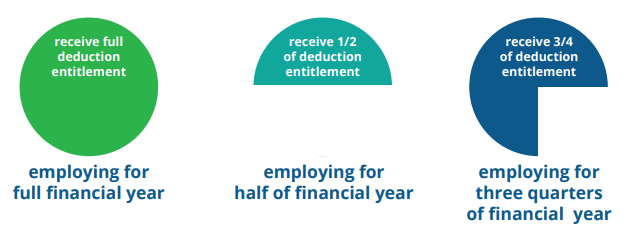
Employers not wishing to claim a deduction entitlement amount are required to pay tax at the relevant rate on the total South Australian wages for the month.
For employers who also employ interstate, their deduction entitlement is calculated using the formula below:
Taxable SA Wages
Taxable Australia Wide Wages
x Maximum Deduction x
No. of Days Employing in SA*
* Equals the number of days in the relevant financial year of which the employer paid or was liable to pay taxable wages.
**366 days should be used if a leap year
Employers who are members of a group are not all entitled to a deduction. The group is required to designate one of its members to claim the deduction entitlement on behalf of the group. This member is known as the Designated Group Employer (referred to as the DGE). Remaining group members are not able to claim any deduction entitlement in their returns unless, during the annual reconciliation process, it is identified that there is an unused component of the deduction.
RevenueSA must be informed, in writing, whenever there is a change in the group membership. RevenueSA will advise the action to be taken to establish the deduction entitlement of the group.
Calculation of tax: employer and groups who only pay wages in South Australia
If an employer carries on employment activity only in South Australia for the full financial year, the employer is entitled to a full deduction. If a group exists, the DGE may claim the full deduction; all other members of the group are required to pay tax on their total South Australian wages.
Example: Non-group - small businessTiny Pty Ltd is a non-group employer who pays wages in South Australia only. The estimated total wages for the 2022-23 financial year are $1,560,000. A reduced payroll tax rate of 1.48% is applied as the estimated wages are between $1,500,000 and $1,700,000. During March 2023, Tiny Pty Ltd paid wages of $130,000. The company’s payroll tax liability for March 2023 is: ($130,000 - $50,000) x 1.48% = $1,184.00
Example: Non-groupM.Ployer Pty Ltd is a non-group employer who pays wages in South Australia only. The estimated total wages for the 2022-23 financial year are $4,200,000. A payroll tax rate of 4.95% will apply as the estimated wages are above $1,700,000. During March 2023, M.Ployer Pty Ltd paid wages of $350,000. The company’s payroll tax liability for March 2023 is: ($350,000 - $50,000) x 4.95% = $14,850.00
Example: GroupM.Ployer Pty Ltd and I.2.M.Ploy Pty Ltd are group employers. They pay wages in South Australia only and M.Ployer Pty Ltd is the group’s DGE. The estimated total group wages for the 2022-23 financial year are $6,240,000. A payroll tax rate of 4.95% will apply as the estimated wages are above $1,700,000. The wages paid during March 2023 are: M.Ployer Pty Ltd $400,000 I.2.M.Ploy Pty Ltd $120,000 Total Wages $520,000 As the DGE, M.Ployer is entitled to claim a monthly deduction of $50,000. They are entitled to the full deduction as the group only pays wages in South Australia. I.2.M.Ploy Pty Ltd is not entitled to a deduction and must pay tax on the full wages amount. The company’s payroll tax liabilities for March 2023 are: M.Ployer Pty Ltd: ($400,000 - $50,000) x 4.95% = $17,325.00 I.2.M.Ploy Pty Ltd: $120,000 x 4.95% = $5,940.00 Total tax payable: $23,265.00
Calculation of tax: employer and groups that pay wages in South Australia and interstate
Where an employer, or at least one member of a group, carries on employment activity, both in South Australia and elsewhere in Australia, they are entitled to a proportional deduction only. The proportional entitlement bears the same relationship to the maximum deduction as South Australian wages bear to total Australian wages.
Example: Non-group - small businessTiny Pty Ltd is a non-group employer who pays wages in South Australia and Victoria. The total estimated wages for 2022-23 are as follows: South Australia $800,000 South Australia $800,000 Victoria $800,000 Australian Total $1,600,000 A reduced payroll tax rate of 2.47% is applied as the estimated wages are between $1,500,000 and $1,700,000. The deduction entitlement is calculated as follows: (South Australian Wages ÷ Australian Wages) x Maximum deduction (currently $600,000) ($800,000 ÷ $1,600,000) x $600,000 = $300,000 ($25,000 per month) During March 2023, Tiny Pty Ltd paid $75,000 wages in South Australia. The company’s payroll tax liability for March 2023 is: ($75,000 - $25,000) x 2.47% = $1,235.00
Example: Non-groupM.Ployer Pty Ltd is a non-group employer who pays wages in South Australia and Victoria. The total estimated wages for 2022-23 are as follows: South Australia $500,000 Victoria $1,500,000 Australian Total $2,000,000
A payroll tax rate of 4.95% will apply as the estimated wages are above $1,700,000. The deduction entitlement is calculated as follows: (South Australian Wages ÷ Australian Wages) x Maximum deduction (currently $600,000) ($500,000 ÷ $2,000,000) x $600,000 = $150,000 ($12,500 per month) During March 2023, M.Ployer Pty Ltd paid $40,000 wages in South Australia. The company’s payroll tax liability for March 2023 is: ($40,000 - $12,500) x 4.95% = $1,361.25
Example: GroupM.Ployer Pty Ltd and I.2.M.Ploy Pty Ltd are group employers. They pay wages in South Australia and Victoria. M.Ployer Pty Ltd is the group’s DGE. The group’s total estimated wages for 2022-23 are as follows: South Australia $800,000 Victoria $1,200,000 Australian Total $2,000,000
A payroll tax rate of 4.95% will apply as the estimated wages are above $1,700,000. The deduction entitlement is calculated as follows: (South Australian Wages ÷ Australian Wages) x Maximum deduction (currently $600,000)
($800,000 ÷ $2,000,000) x $600,000 = $240,000 ($20,000 per month) As the DGE, M.Ployer is entitled to claim a monthly deduction of $20,000. This is a reduced deduction as the group pays wages in South Australia and Victoria. I.2.M.Ploy Pty Ltd is not entitled to a deduction and must pay tax on the full wages amount. During March 2023, M.Ployer Pty Ltd paid $65,000 and I.2.M.Ploy Pty Ltd $40,000 wages in South Australia. The companies’ payroll tax liability for March 2023 are: M.Ployer Pty Ltd: ($65,000 - $20,000) x 4.95% = $2,227.50 I.2.M.Ploy Pty Ltd: $40, 000 x 4.95% = $1,980.00 Total tax payable $4,207.50
Payment of payroll tax
RevenueSA Online facilitates the lodgement and payment of monthly returns and the annual reconciliation return. All payroll tax returns must be lodged via RevenueSA Online. More details on the functions provided through RevenueSA Online can be found on our RevenueSA Online page. If payroll tax is not paid by the due date, interest and/or penalty tax may be imposed. RevenueSA Online also allows a ‘nil’ return to be lodged if there is no payroll tax liability for a particular month. Payment of payroll tax may be made via one of the following options:
Payroll Tax Electronic Payment Authority (EPA)
Taxpayers paying via EPA are required to nominate a bank account for payment. The electronic payment must be initiated by the user within RevenueSA Online, RevenueSA does not independently access the taxpayer’s bank account. An employer needs to complete an Application (PDF 302KB) to use this facility.
Payroll Tax Electronic Funds Transfer (EFT)
Users must log into RevenueSA Online to lodge and complete an expected EFT return each month. This will generate an EFT Payment Advice containing the BSB, Account Number and Payment Reference Number. The Payment Reference Number changes for each return period. The correct Payment Reference Number for the return period must be used when making payment. If the incorrect number is used, payment may be returned and non-payment penalties and bank fees may result. The correct Payment Reference Number for each return period is only provided after an expected return on RevenueSA Online is submitted. Once a Payment Advice is generated the details contained are used to make payment via EFT with a financial institution. The payment advice generated from RevenueSA Online is not required to be submitted if payment is made by EFT.
BPAY
If payment is made by BPAY it is important that the correct Biller Code and Reference Number printed on the Payroll Tax Payment Advice (generated from RevenueSA Online) or Assessment Payment Advice is used. This will ensure correct allocation of the payment. If the incorrect number is used, the payment may not be allocated as intended and penalty tax and interest may result. Please note that a different reference number is provided on each Payroll Tax Payment Advice or Assessment Payment Advice. The Payment Advice generated from RevenueSA Online is not required to be submitted if payment is made by BPAY. BPAY payments for payroll tax from a credit account will not be accepted.
Wages subject to payroll tax
When are wages subject to payroll tax in South Australia?
- Payroll tax is payable in the jurisdiction where the employee’s principal place of residence is located.
- If an employee does not have a principal place of residence in any Australian jurisdiction during the relevant month, payroll tax is payable in the jurisdiction where the employer has registered their Australian Business Number (ABN) address.
Overseas employment
Employees working in another country for 6 months or less
Where an employee is working in another country or countries for a period of 6 months or less, a payroll tax liability arises in South Australia if the wages are paid or payable in South Australia.
Employees working in another country for more than 6 months
If an employee is working in another country or countries for a continuous period of more than 6 months, then the wages paid or payable to that employee for the whole period will be exempt from payroll tax. In these circumstances, the 6 month period need not be within the same financial year, but must be a continuous period.
Should an employee that is working in another country return to Australia, it will not be considered to be a break in continuity of their overseas employment if the employee returns to Australia under the following circumstances:
- for a holiday; or
- to perform work exclusively related to the overseas assignment for a period of less than one month.
In either case, the employee must immediately return to that country or another country to continue their overseas employment.
Services performed offshore
Where an employee is working outside all Australian jurisdictions, but not in another country, the wages are taxable in the Australian jurisdiction in which the wages are paid or payable. The exemption available for employees working in another country or countries would not apply in this circumstance.
Wages paid for services performed offshore, but within the territorial (coastal) limits of South Australia are liable for payroll tax and must be included in your payroll taxable wages.
For payroll tax purposes, South Australia’s coastal border is taken to be the ‘mean low watermark baseline’ which is the territorial seas that follows the low watermark of South Australia’s mainland and islands and deviates offshore across river mouths and bays if less than 24 nautical miles in width.
Shares and options
Where wages comprise the grant of a share or option, the payroll tax liability (for the grant of a share or option) is also governed by the new nexus rules.
See the definition of wages section for more information on shares and options.
However, certain circumstances relating to shares and options attract different nexus rules. These are outlined as follows:
- The employee performs services in more than one Australian jurisdiction and/or partly overseas, and the employee does not have a PPR in an Australian jurisdiction, and the employer does not have a registered business address or a PPB in an Australian jurisdiction and the shares/options relate to an Australian company.
- The employee performs services wholly outside all Australian jurisdictions for less than 6 months but is paid in an Australian jurisdiction.
In these situations, where the grant of a share or option constitutes wages, the shares or options are taken to be paid or payable in the jurisdiction where the Australian company is registered.
See Revenue Ruling PTA039: Payroll Tax Nexus Provisions for further guidance on the application of the nexus provisions.
Definition of wages
Having established the circumstances in which wages are taxable in South Australia, it is necessary to consider what constitutes ‘wages’.
The definition of ‘wages’ in the Payroll Tax Act 2009 is broad and is not restricted to wages or salaries.
The term ‘wages’ includes:
- salaries and wages;
- remuneration;
- bonuses;
- commissions;
- allowances;
- employment termination payments and accrued leave paid on termination;
- fringe benefits;
- shares and options;
- employer-funded (pre-income tax) superannuation contributions including non-monetary contributions;
- salary sacrifice; and
- any remuneration paid to or in relation to company directors or members of the governing body (for example, directors’ fees).
This list is not exhaustive.
See the checklist of taxable items section for further guidance on the types of payments that are subject to payroll tax.
Payments to on-hired employment agency workers or relevant contractors may also be taxable.
See the contractors and employment agency contract sections for more information.
If you are uncertain on whether a particular class of worker or payments made to them is subject to payroll tax please contact RevenueSA.
Indirect payments
‘Wages’ do not have to be paid directly by an employer to an employee in order to be taxable. Payments to a person other than an employee, or payments by a person other than the employer, are subject to tax where the payments are made in relation to an employee’s services. For example, an entertainment allowance paid to an employee’s spouse is taxable as it is a payment to a third party in relation to the employee’s services.
Wages & salaries
Taxable wages and salaries are the gross wages and salaries paid including any Pay-As-You-Go (PAYG) withholding amounts or other deductions made by an employer on behalf of an employee. Taxable wages include such payments as overtime pay, penalty payments, sick pay, holiday pay and leave loadings.
Goods & Services Tax (GST)
Payroll tax is not payable on the Goods and Services Tax (GST) component that may arise in payments to employees or deemed employees.
Annual, sick & long service leave payments
Annual leave, sick leave and long service leave payments made to an employee who will be continuing in the service of their employer and payments made in lieu of accrued annual, sick, long service or pro-rata leave at termination of employment, are liable to payroll tax where any such payment represents a reward for service to which the employee has a pre-existing enforceable right.
Payments relating to accrued leave entitlements are liable to payroll tax, whether paid on, before or after termination of the employee’s services.
Similarly, any payment of deferred or accrued wages, salaries, commissions, bonuses, allowances, etc. is liable to payroll tax whenever paid.
Jury duty
There is no exemption in respect of payments made to an employee who is on jury duty.
Allowances
As a general rule, allowances are taxable in full even if they are paid to compensate an employee for an expense which may be (or has been) incurred in relation to work (for example, uniform allowances). This is the case even if an allowance is paid under an award or employment agreement (for example, overtime meal allowances).
The only exceptions to the general rule that allowances are taxable in full are motor vehicle allowances, accommodation allowances and living away from home allowances.
Motor vehicle allowances
A motor vehicle allowance paid or payable to an employee is taxable only to the extent that it exceeds the exempt rate per kilometre, or an amount calculated as the exempt component. The exempt component is calculated as follows:
E = K x R
E is the exempt component
K is the number of business kilometres travelled during the financial year
R is the exempt rate
The number of business kilometres travelled during the financial year is determined by either:
- a continuous recording method during the financial year;
- the Australian Taxation Office (ATO) 12-week averaging method; or
- some other method the Commissioner may approve in writing.
If the number of business kilometres is not recorded via one of the methods described above, the full allowance will be taxable.
The exempt rate is aligned with the rate determined by the Federal Commissioner of Taxation for the previous financial year (the rate used in 2022-23 is the Australian Taxation Office 2021-22 rate).
For 2022-23, the motor vehicle allowance exempt rate for payroll tax purposes is $0.72 per kilometre.
See the rates and thresholds page for previous exempt rates.
Where a motor vehicle allowance is paid as a set allowance (rather than on a cents per kilometre basis), the taxable amount is the amount by which the set allowance exceeds the amount calculated by multiplying the actual kilometres travelled by the prescribed rate.
The exemption of a prescribed portion of a motor vehicle allowance payment applies only where the travelling allowance is paid or payable for business travel purposes using a motor vehicle supplied by the employee.
See Revenue Ruling PTA025: Motor Vehicle Allowance Paid to Real Estate Salespersons for information on motor vehicle allowances paid to real estate salespersons.
Accommodation allowances
An accommodation allowance paid or payable to an employee is taxable only to the extent that the allowance exceeds the exempt rate. Wages do not include an accommodation allowance that does not exceed the exempt rate.
The exempt rate for payroll tax purposes is based on the related Australian Taxation Office figure, and is the total reasonable amount for daily travel allowances using the lowest capital city for the lowest salary band for the financial year.
For 2022-23, the accommodation allowance exempt rate for payroll tax purposes is $289.15 per night (Room $147.00, Incidentals $21.30, Meals $120.85).
See the rates and thresholds page for previous exempt rates.
The exemption applies only where the accommodation allowance is designed to compensate an employee for accommodation and directly related meal expenses necessarily incurred where an employee is required, in the course of employment, to be absent overnight from their usual place of residence.
See Revenue Ruling PTA024: Overnight Accommodation Allowances Paid to Truck Drivers for information on accommodation allowances paid to truck drivers.
Living away from home allowances
A living away from home allowance is paid to compensate an employee for additional expenses they may incur as a result of being required to temporarily live away from home in order to perform their duties of employment. This usually occurs where the employee has been required to work temporarily at another location, which necessitates a temporary change in residence. The allowance will include components designed to compensate for additional food and accommodation costs. It is distinguishable from a travel allowance which is paid to an employee to compensate for accommodation, meals and incidental expenses incurred while the employee is travelling on a short-term assignment not involving a temporary relocation of the employee’s place of employment.
Generally, a living away from home allowance is a fringe benefit under Section 30 of the Fringe Benefits Taxation Assessment Act 1986 (Cwlth).
If the allowance falls within the definition of a living away from home allowance under Section 30 of the Fringe Benefits Taxation Assessment Act 1986 (Cwlth), the taxable value of the benefit under the Fringe Benefits Taxation Assessment Act 1986 (Cwlth), grossed-up by the Type 2 factor as shown on the FBT Return is subject to payroll tax. However, if the allowance is not considered a living away from home allowance under the Fringe Benefits Taxation Assessment Act 1986 (Cwlth), the treatment of the allowance for payroll tax purposes will be the same as the treatment of an accommodation allowance (see above).
Reimbursements
Reimbursements of expenses incurred by employees on behalf of their employers are not taxable unless they have a taxable value under the Fringe Benefits Taxation Assessment Act 1986 (Cwlth).
For a payment to be considered a reimbursement, it must have the following 2 characteristics:
- the expense must be incurred by the employee and the precise amount is reimbursed, or if the payment was made in advance, a receipt relating to the expense must be given to the employer along with any change; and
- the expense must be incurred in the course of the employer’s business.
If a payment does not have both characteristics, it is not considered a reimbursement and is generally taxable in full.
Termination payments
The Payroll Tax Act 2009 provides that certain payments made to an employee on termination of employment are subject to payroll tax. Specifically, the following payments are taxable:
- payments for actual services rendered up to the date of termination;
- accrued annual and long service leave; and
- employment termination payments.
Accrued leave
Both accrued annual leave and long service leave payments are taxable when paid to an employee on termination of the employee’s services. It should be noted that leave payments paid to a continuing employee are also subject to payroll tax.
Employment termination payments
Payroll tax applies to an employment termination payment (formerly eligible termination payment), as defined in Section 82-130 of the Income Tax Assessment Act 1997 (Cwlth), when paid by an employer as a result of an employee’s termination.
The amount subject to payroll tax is the whole of the employment termination payment paid by the employer (whether paid to the employee or to a roll-over fund), less any component, which is exempt income when received by the employee. Employment termination payments paid by employers may include payments for:
- unused sick leave or rostered days off;
- ex gratia payments or ‘golden handshakes’;
- payment in lieu of notice or service contract payouts;
- compensation for loss of job or wrongful dismissal; or
- bona fide redundancy or early retirement payments in excess of the income tax free limit. (The income tax free components of such payments do not form part of an employment termination payment and are, therefore, not subject to payroll tax).
Fringe benefits
The definition of wages for payroll tax purposes includes any fringe benefits as defined in the Fringe Benefits Taxation Assessment Act 1986 (Cwlth).
Therefore, as a general rule, benefits that are taxable under the Fringe Benefits Taxation Assessment Act 1986 (Cwlth) are also taxable under the Payroll Tax Act 2009 and must be declared as wages for payroll tax purposes. The only exception to this general rule is a tax-exempt body entertainment fringe benefit as defined in the Fringe Benefits Taxation Assessment Act 1986 (Cwlth). Although tax-exempt body entertainment fringe benefits are subject to fringe benefit tax, they are specifically exempt for payroll tax purposes.
If a benefit is exempt under the Fringe Benefits Taxation Assessment Act 1986 (Cwlth) (for example, a laptop computer) it is also exempt from payroll tax. In addition, if a fringe benefit has a nil taxable value for fringe benefit tax purposes (for example, the taxable value is reduced to nil under the otherwise deductible rule), it also has a nil taxable value for payroll tax purposes.
Records used to substantiate fringe benefit tax claims made to the Australian Taxation Office are also acceptable for payroll tax.
Calculating the fringe benefit value
Under the Fringe Benefits Taxation Assessment Act 1986 (Cwlth), fringe benefits are categorised into two types depending on the GST implications:
- Type 1 fringe benefits for which the employer can claim a GST input tax credit; and
- Type 2 fringe benefits for which the employer cannot claim a GST input tax credit.
The fringe benefit taxable value for payroll tax purposes is determined by grossing up all fringe benefits by using only the Type 2 factor.
Gross-up rates for fringe benefits are available on the Australian Taxation Office website.
Please note that the Australian Taxation Office requires that certain fringe benefits, referred to as the ‘reportable fringe benefits amount’, must be shown on the employee’s payment summary if the benefits amount exceeds $2,000. These reportable fringe benefits may not include the value of all fringe benefits provided to employees and is not necessarily the amount to be used for payroll tax purposes.
Declaring fringe benefit value
Employers are required to declare in their monthly returns the actual value of fringe benefits provided in each month. However, for administrative ease, past and present payroll tax legislation allows employers to formally elect to adopt an alternative method, whereby the amounts declared are based on the fringe benefit tax returns submitted to the Australian Taxation Office.
Where such an election is made, employers must include in each monthly payroll tax return from July to May, one-twelfth of the taxable value (for payroll tax purposes) of fringe benefits using the fringe benefit tax return for the year ending 31 March immediately preceding the start of each financial year. The annual reconciliation for each financial year will include the taxable value (for payroll tax purposes) of fringe benefits declared in the fringe benefit tax return ending 31 March immediately before the annual reconciliation.
Once an election is made, an employer will not be permitted to revert to declaring the actual value of fringe benefits in monthly payroll tax returns, unless the Commissioner gives approval in writing.
An employer must not use a combination of methods.
Share & options
The value of an employer’s contribution to any grant of a share or option to an employee or deemed employee, a director or former director, member or former member of the governing body of the company constitutes wages and is subject to payroll tax.
The granting of a share or an option occurs if a person acquires a share or, in the case of an option, a right to the share.
A value of the share or option becomes liable on the ‘relevant day’. The employer can elect to treat the relevant day as either the date that the share or option is granted to the employee, or the ‘vesting date’. Once an election is made in respect of a particular share or option it cannot be amended.
The vesting date for a share is the date when any conditions applying to the grant of the share have been met and the employee’s legal or beneficial interest in the share cannot be rescinded. The vesting date for a share is the earlier of either the date as defined above or the date at the end of 7 years from the date on which the share is granted to the employee.
The vesting date for an option is the earlier of either one of the three dates. The dates are:
- when the share to which the option relates is granted to the employee;
- when the right under the option to have the relevant share transferred, allotted or vested is exercised by the employee; or
- at the end of the period of 7 years from the date on which the option is granted to the employee.
If the granting of a share or option constitutes wages, the amount of the wages is the value of the share or option on the relevant day, less any consideration paid or given by the employee for the grant (excluding consideration in the form of services rendered). The value of a share or an option is the market value or the amount determined as provided for in Section 83A-315 of the Income Tax Assessment Act 1997 (Cwlth) and Division 83A of the Income Tax Assessment Regulations 1997 (Cwlth).
Start-up companies can use one of two ‘safe harbour’ methods for valuing unlisted shares. The ‘net tangible asset’ method and the ‘comprehensive value’ method. If a start-up company choses an alternative method resulting in a higher market value, we accept that value for payroll tax methods.
If an employer does not include the value of a grant of a share or option in its taxable wages for the financial year in which the grant occurred, the wages constituted by the grant are taken to have been paid or payable on the vesting date of the share or option.
The employer may reduce the taxable wages declared by the value of any previously declared share or option value, if the grant of a share or option was rescinded because the vesting conditions have not been met. However, this reduction in the taxable wages would not apply in circumstances where the employee decided not to exercise the option.
If the grant of a share or option is withdrawn, cancelled or exchanged before the vesting date for some valuable consideration (other than the grant of other shares or options), the date on which that occurs is deemed to be the vesting date and the taxable amount is taken to be the value of the consideration.
The 7 year vesting date still applies to shares and options that have been forfeited or lapsed prior to seven years from the grant date if the other specified events have not occurred for those cases where the employer has elected the vesting date as the relevant date. However, as such shares/options have been forfeited or lapsed prior to 7 years from the grant date, the value of the shares/options at the 7 year vesting date is regarded as being nil because the share/option does not exist at that time.
Superannuation contributions
The definition of wages includes all employer-funded superannuation contributions.
Superannuation subject to payroll tax includes employer contributions paid or payable:
- to a superannuation fund within the meaning of the Superannuation Industry (Supervision) Act 1993 (Cwlth);
- as a superannuation guarantee charge within the meaning of the Superannuation Guarantee (Administration) Act 1992 (Cwlth);
- to or as a form of superannuation, provident or retirement fund or scheme, including to the Superannuation Holding Accounts Special Account within the meaning of the Small Superannuation Accounts Act 1995 (Cwlth), and a retirement savings account within the meaning of the Retirement Savings Accounts Act 1997 (Cwlth);
- involving the crediting of an account of an employee, or any other allocation to the benefit of an employee (other than the actual payment of a contribution), or the crediting or the debiting of any other account, or any other allocation or deduction, so as to increase the entitlement or contingent entitlement of the employee under any form of superannuation, provident or retirement fund or scheme; or
- in respect of an employee who is a member of the old or new scheme of superannuation under the Superannuation Act 1988 or of any other unfunded or partly funded scheme of superannuation. The Treasurer may estimate the contingent liability of an employer for contributions that will be payable and that estimate may be treated as a contribution paid or payable by an employer in respect of an employee for the purposes of the definition of a superannuation contribution.
Please note that taxable superannuation contributions include:
- superannuation contributions paid or payable in respect of a company director (including a non-employee director), or in respect of a person taken to be an employee under the contractor provisions in Division 7;
- non-monetary contributions to a superannuation fund on behalf of an employee, a contractor deemed to be an employee or a director. The value of these contributions is to be worked out in accordance with Section 43.
Contribution holidays
In respect of contribution holidays, where it is determined that an employer is on a contribution holiday, as a result of a superannuation fund being in surplus, and the trustee(s) during that period nonetheless credit amounts to accounts of individual members of the fund, such crediting will be considered a superannuation benefit, and therefore will constitute wages liable to payroll tax.
Salary sacrifice arrangements
Employers who make payments to a superannuation fund(s) of its employee’s or director’s choice as part of a salary packaging arrangement (salary sacrifice arrangements) are subject to payroll tax.
A salary sacrifice arrangement refers to an arrangement between an employer and the employee whereby the employee agrees to forego part of their future salary or wage in return for some other form of non-cash benefits of equivalent cost to the employer.
The non-cash benefits provided may include pre-tax superannuation contributions, the provision of a motor vehicle, a laptop computer or similar portable computer, car parking fees, payment of school fees or the payment of membership fees and subscriptions.
The Australian Taxation Office treats ‘effective salary sacrificing arrangements’ and ‘ineffective salary sacrificing arrangements’ differently.
Please contact the Australian Taxation Office for further information about the income tax treatment of ‘effective’ and ‘ineffective’ salary sacrifice arrangements
Under an effective salary sacrifice arrangement:
- the employee pays income tax on the reduced salary or wage;
- salary sacrificed (pre-tax) superannuation contributions are classified as employer contributions (not employee contributions); and
- the employer may be liable to pay fringe benefit tax on the fringe benefits provided.
- The payroll tax treatment under an effective salary sacrifice arrangement is as follows:
- the reduced salary or wage on which the employee pays income tax is treated as taxable wages;
- the pre-tax superannuation contribution classified as the employer contribution is taxable; and
- the taxable value of the benefit under the Fringe Benefits Taxation Assessment Act 1986 (Cwlth), grossed-up by the Type 2 factor as shown on the Fringe Benefit Tax Return is taxable.
If the benefit provided to the employee is exempt from fringe benefit tax (for example, laptop computer) no payroll tax is payable in respect of the amount sacrificed for that benefit. Payroll tax is payable only on the reduced salary on which the employee pays income tax.
Some employees agree to make regular donations to charitable organisations of their choice under a ‘Workplace Giving’ program. This arrangement is not a salary sacrifice arrangement because the Australian Taxation Office requires that the normal gross salary must be stated on the employee’s payment summary. Payroll tax is payable on the normal gross salary.
The following examples outline the payroll tax treatment of various salary sacrifice arrangements.
Example 1
An employee has a current salary of $70,000 per annum. The employee negotiates with the employer for the provision of a car under a salary sacrifice arrangement.
The new salary will be reduced to $58,000 per annum. The taxable value grossed-up by the Type 2 factor of the motor car for fringe benefit tax purposes is $6,350. Payroll tax will be payable on the $58,000 salary and the fringe benefit tax taxable value grossed-up by the Type 2 factor of $6,350.
Example 2
An employee’s current salary is $65,000 per annum. The employee negotiates with the employer for the purchase of a laptop computer (cost of $3,000) under a salary sacrifice arrangement.
The new salary will be reduced to $62,000 per annum. The laptop is exempt from fringe benefit tax. Therefore, payroll tax is payable on the $62,000 salary.
Example 3
An employee’s current annual salary is $60,000. The employee also makes after-tax (personal) superannuation contributions of $5,400 per annum. The employee negotiates with the employer to replace the after-tax superannuation contributions with salary sacrifice (pre-tax) contributions.
Therefore, the salary for the next financial year will be reduced to $54,600 and the employer will make a pre-tax superannuation contribution of $5,400. Payroll tax is payable on the $54,600 salary and the employer pre-tax superannuation contribution of $5,400.
Remuneration to directors or members of the governing body
Remuneration to directors or members of the governing body, such as director fees, superannuation, allowances, fringe benefits and shares and options, are subject to payroll tax. This applies to both directors or members of the government body whether working or non-working.
Contractors
Under certain circumstances, payments to contractors are taxable. Generally, those circumstances are where the contractor:
- provides essentially labour services; and
- works exclusively or primarily for one principal.
The provisions relating to contractors deem such contractors to be ‘employees’ and the payments made to them, excluding GST, are deemed to be wages.
The term ‘contractors’ is a generic one, which includes sub-contractors, consultants and outworkers. The provisions apply regardless of whether the contractor provides services via a company, trust, partnership or as a sole trader.
In practical terms, the contractor provisions initially capture all contracts for the performance of work. However, the provisions contain several exemptions and if any one exemption applies to a particular contract, the payments under that contract are not taxable.
These provisions also allow the Commissioner to disregard, and treat as taxable, an arrangement that exists only to reduce or avoid payroll tax.
For certain types of contractors where the contractor provides equipment and/or materials, the Commissioner allows a percentage deduction from gross payments for non-labour components.
See Revenue Ruling PTA018: Contractor Deductions for further information on the types of contractors and their deduction percentages.
Two contractor decision tools are available to assist you in determining whether any payments made to contractors are liable for payroll tax.
Employment agency contracts
The employment agency provisions in Division 8, Part 3 apply to a labour hire arrangement where a person (the employment agent) contracts with another (the client) for the provision of labour where there is no agreement between the service provider (i.e. contract worker) and the client. Employment agencies who engage persons to provide services to their clients under an employment agency contract are liable to payroll tax. Payroll tax is calculated on any amount paid to the contract worker from any source in relation to that contract and the value of any fringe benefits and superannuation contributions provided for the contract worker.
Section 38 deems an employment agent under an employment agency contract to be the employer, and the contract worker under an employment agency contract to be an employee of the employment agent.
Any payments made by the employment agent to or on behalf of the contract worker, including fringe benefits and superannuation, are deemed to be wages for payroll tax purposes and are subject to payroll tax.
Care should be taken in determining if the employment agency provisions contained in Section 37 apply to your organisation.
These provisions apply regardless of whether the relationship between the contract worker and the employment agency is one of principal/contractor or employer/employee.
Where the Employment Agency provisions DO apply the following amounts will not be taxable:
- any amount paid in respect of the employment agent’s fee(s);
- any amount paid in respect of services provided to a client that was an exempt employer under the provisions of Part 4 except for Division 4 or 5 of that Part, Section 50 or under Part 3 of Schedule 2 (other than clause 17). In these situations, the exempt employer is to provide the employment agent with a statement stating that they are exempt from payroll tax.
Please note that the relevant contractor provisions are not applicable where a contract worker is provided under an employment agency contract.
Exempt wages and other non-liable payments
Apprentices and Trainees
Wages paid to apprentices and trainees who commenced a relevant training contract between 10 November 2020 and 30 June 2022 (inclusive), will receive relief equivalent to a 12 month payroll tax exemption. See the payroll tax exemption page for more information.
Workers compensation
An employer is not liable to payroll tax in respect of payments made to an employee under the provisions of the Return to Work Act 2014, including compensation payments made by a ReturnToWorkSA exempt employer and income maintenance payments of not more than 2 weeks wages made under the provisions of the Return to Work Act 2014. In relation to self-insurers, all compensation made pursuant to the provisions of the Return to Work Act 2014 is exempt from payroll tax, regardless of whether the compensation is paid by the employer (or their insurer) or ReturnToWorkSA. However, compensation paid to incapacitated workers by the employer (or their insurer), in excess of the amount prescribed by the Return to Work Act 2014 (‘make-up pay’), will be subject to payroll tax.
Redundancy payments
A genuine redundancy payment or early retirement payment paid to an employee on termination is exempt from payroll tax if it is exempt from income tax. However, the exemption applies only to the income-tax-free component of such a payment. Any amount of a genuine redundancy payment or early retirement payment, paid in excess of the income-tax-free limit, is subject to payroll tax.
Maternity & adoption leave
- all wages (other than fringe benefits) paid to female employees taking maternity leave and male or female employees taking adoption leave are exempt;
- the exemption does not apply to paid sick leave, recreation leave, long service leave or similar leave taken while the employee is absent due to a pregnancy or adoption;
- the exemption is limited to a maximum equivalent of 14 weeks full-time pay for full-time employees and 14 weeks part-time pay for part-time employees; and
- the exemption applies irrespective of whether the leave is taken before or after the birth or adoption.
For further guidance on the treatment of maternity and adoption leave, please refer to Revenue Ruling PTA012: Exemption for Maternity and Adoption Leave Pay.
Employers who claim the exemption for maternity leave must obtain a medical certificate or statutory declaration from the employee in relation to the pregnancy or birth of the child. Similarly, employers who claim the exemption for adoption leave must obtain a statutory declaration from the employee that an adoption order has been made or that the child is in the employee’s custody pending such an order.
Payments made by an employer to an employee under the Commonwealth Paid Parental Scheme are not taxable for payroll tax as they are not payments for services performed by the employee.
For further guidance on the treatment of payment made under the Commonwealth Paid Parental Scheme, please refer to Revenue Ruling PTA037: Paid Parental Leave.
Defence force payment
Payments to employees who are absent from work due to being a member of the Defence Force of the Commonwealth or the armed forces of any part of the Commonwealth of Nations are exempt from payroll tax. It does not apply to employees who are on official leave (for example, recreation or long service leave).
Volunteer emergency workers
Payments to employees who are absent from work to volunteer as fire fighters, or to respond to other emergencies, are exempt from payroll tax. This exemption may apply to emergency workers volunteering for organisations such as the South Australian:
- Country Fire Services (CFS);
- Metropolitan Fire Services (MFS); and
- State Emergency Services (SES).
It does not apply to employees who are on official leave (for example, recreation or long service leave).
Community Development Program (CDP)
Wages paid to an indigenous person who is employed under a Community Development Program (formerly Community Development Employment Project) funded by the Commonwealth Department of Education, Employment and Workplace Relations, or the Torres Strait Regional Authority, are exempt from payroll tax.
Construction Industry Long Service Leave Contributions
Construction Industry Long Service Leave Contributions made under the Construction Industry Long Service Leave Act 1987 are exempt from all taxes and other charges imposed under the law of South Australia and therefore not taxable for payroll tax purposes.
Grouping of employers
- corporations are related under Section 50 of the Corporations Act 2001 (Cwlth);
- there is an inter-use or sharing of employees between 2 or more businesses;
- the same person has (or 2 or more persons, together, have) a controlling interest in each of 2 or more businesses (where those businesses are carried on by separate legal entities); or
- an entity (that is, a person or set of associated persons) has a controlling interest in a corporation.
If a person is a member of 2 or more groups, the members of all the groups together constitute a group.
It is important to note that where the same person owns 2 or more businesses (that operate under the same Australian Business Number [ABN]), it is not necessary to consider the grouping provisions. In such cases, there is only one employer for payroll tax purposes and the wages paid in respect of each business must be combined in the return lodged by that employer.
Joint and several liability of group members
Any tax (including interest and/or penalty tax) payable under the Act and/or TAA by a member, or members of a group, is a debt due jointly and severally by every group member (employer or not) who was a member of the group during the period in respect of which the liability arose.
Exclusion from a group
The Commissioner has discretion to exclude a member from a group if satisfied, having regard to the nature and degree of ownership and control of the businesses, the nature of the businesses and any other matters the Commissioner considers relevant, that a business conducted by that member is carried on independently of, and is not connected with the carrying on of, a business carried on by the any other member of the group.
However, this discretion is not available for a group constituted under Section 50 of the Corporations Act 2001 (Cwlth) other than where a corporate trustee is involved.
To apply for exclusion please complete an Application to Exclude from a Group (PDF 72KB).
Administration issues
Duties of agents, trustees, liquidators etc.
An agent, trustee, executor or a liquidator is answerable as an employer for doing all things required by the Act in respect of wages paid as a representative. The representative must register as an employer, lodge payroll tax returns and pay the required tax if the wages paid or payable by the representative are liable for payroll tax. Each payroll tax return lodged by a representative must be separate and distinct from any other return. A representative is entitled to recover any tax paid in that capacity from the person on whose behalf it was paid or the representative may deduct the payroll tax from any money belonging to that person held by the representative. A representative is personally liable for the payroll tax payable if, after the Commissioner has requested the representative to make a return or while the tax remains unpaid, the representative disposes of funds or assets from which the payroll tax legally could be paid, without the written permission of the Commissioner. The returns lodged by an executor of a deceased estate must be the same, as far as practicable, as the deceased person, if living, would have been liable to make. The Commissioner has the same powers to recover payroll tax from the trustee or executor or administrator of an estate, as they would have had against the employer if that person were alive.
Liquidators
A liquidator is required to give notice to the Commissioner of their appointment as liquidator within 14 days of that appointment.
Update contact information
The legal entity name and contact details can be modified online via RevenueSA Online, and can be done quickly and easily without the need to notify RevenueSA in writing or send any supporting documentation. To update contact details online, simply login to RevenueSA Online (using your username and password) and select update details from the menu to modify current details. Access RevenueSA Online at: revenuesaonline.sa.gov.au
Interest for late payment of tax
- a market rate; and
- a statutory rate (currently 8%).
Pursuant to Section 26(2) of the Taxation Administration Act 1996, the ‘market rate’, in relation to interest accruing at any time during a particular financial year, is the average rate of the 90-day Bank Accepted Bill Rate prescribed by the Reserve Bank of Australia for the month of May preceding the financial year, unless a Ministerial order setting the rate is in force.
Interest rates are published on our Interest and Penalty Tax page.
The statutory rate of the interest is 8% per annum, and is charged as a disincentive to taxpayers not meeting their tax obligations in a timely manner.
While a debt remains outstanding, interest will continue to accrue on a daily basis on any outstanding balance until such time that the full amount payable is received. Similarly, if a return remains outstanding, interest payable will be calculated at the time of assessment.
The Commissioner has discretionary powers to remit interest.
Penalty tax for late payment of tax
In addition to interest, the Taxation Administration Act 1996 imposes penalty tax in circumstances where the Commissioner believes that a tax default was deliberate or was a result of the taxpayer (or a person acting on behalf of the taxpayer) failing to take reasonable care to comply with the requirements of a taxation law. In instances of a deliberate default, the Taxation Administration Act 1996 imposes a penalty of 75% and in any other case a penalty of 25%. Penalty tax is applied to ensure compliance with taxation laws and encourage taxpayers to meet their obligations.
Provision is made for a reduction of these penalties, subject to the taxpayer making sufficient disclosure in relation to a tax default, either whilst not subject to a tax audit (80% reduction) or during a tax audit (20% reduction). Provision is made for increasing the penalty tax if a taxpayer engages in obstructive behaviour while subject to a tax audit (20% increase).
The Commissioner has discretionary powers to remit penalty tax.
Record keeping
The Taxation Administration Act 1996 provides that every employer shall keep or cause to be kept, sufficient records, which enable the employer’s liability in respect of payroll tax to be calculated accurately. Those records must be preserved for a period of not less than five years following the completion of any transaction to which they relate.
- shall at all reasonable times, have full and free access to all buildings, places and records for any of the purposes of the Taxation Administration Act 1996 and may make extracts from or copies of such records; and
- may require an employer or any person to attend and give evidence for the purpose of inquiring into that person’s liability or entitlement under the Payroll TaxAct 2009 and may require production of all records.
‘Records’ are defined to include a documentary record or a record made by an electronic, electromagnetic, photographic or optical process or any other kind of record.
Audits and investigations
- detailed Financial Statements/Annual Reports;
- copies of Trust Deeds or Share or Unit Trust Registers or Partnership agreements (for grouping purposes);
- copies of director/shareholder/unit holder/partner meeting Minutes;
- details of wages paid, including Income Statements (previously payment summaries or group certificates), wage books and fringe benefit and superannuation working papers;
- details of wages recorded in computerised or manual payroll system records;
- details of contractors engaged and any associated records;
- cash payment journals;
- general ledger and chart of accounts;
- Australian Taxation Office (ATO) FBT Returns (if applicable), and any fringe benefit tax working papers;
- PAYG Payment Summary Statements; and
- Employer Superannuation Statements from Superannuation Funds.
The initial request will be for specified periods and, depending upon the Investigator’s findings, the scope of the audit may be extended to include additional records and documents, or include further periods.
On occasions, the Commissioner will enter into an agreement with interstate counterparts to perform audits on their behalf or to have an audit conducted for RevenueSA. Such audits will be conducted using reciprocal powers pursuant to the provisions of the Taxation Administration Act 1996.
On completion of an investigation, RevenueSA will divulge relevant information to other jurisdictional revenue offices and/or the Australian Taxation Office, pursuant to the Taxation Administration Act 1996, where such information is pertinent to the assessment of tax by such organisations.
See our Audit and Compliance page for more information.
Objections and appeals
Lodgement of objections
A person who is dissatisfied with an assessment or any other reviewable decision of the Commissioner may, not later than 60 days after the service of the assessment, or notification of a reviewable decision, lodge a written notice of objection with the Minister stating fully and in detail, the grounds on which the person relies. While the Minister has discretion to permit a person to lodge an objection after the end of the 60-day period but not later than after 12 months, the failure or refusal of the Minister to grant permission is a non-reviewable decision. The circumstances concerning and the reasons for the failure to lodge the objection within the 60-day period must be included in the written notice of objection. It should be noted however, that even though an objection is pending, it does not in the meantime affect the assessment to which the objection relates and the Commissioner may recover the tax assessed as if no objection were pending.
Lodgement of appeals
An appeal to the Supreme Court against a decision of the Minister to an objection may be made within 60 days of the date of the Minister’s determination. Appeals need not be restricted to the grounds of the original objection. The Supreme Court has discretion to allow a person to appeal after the end of the 60-day period but not later than after 12 months. Where an appeal is made to the Supreme Court on the grounds of the Minister’s failure to give a determination within 90 days of the lodgement of an objection, the appeal may be lodged at any time, provided the Commissioner is given not less than 14 days written notice of the person’s intention to make the appeal. An appeal cannot be exercised against the decision of the Commissioner or by the Minister on the objection unless 50% of the tax assessed (not including interest or penalty tax) which relates to the appeal has been paid. See the objections and appeals page for more information
Overpayment of tax
Application for refund
Refund requests may be made in respect of tax paid within the last 5 years, providing the Commissioner has not previously made an assessment of the tax liability for which the payment was made. Applications for a refund as a consequence of over-declared wages must be made in writing setting out the wage details which have been over-declared. A refund cannot be approved until such requests have been received. Refunds due as a consequence of an Annual Reconciliation are issued automatically.
Power to offset a credit
The Commissioner has the power to offset a refund or overpayment to an existing debt due under another taxation law. This includes offsetting a refund or overpayment against the debt of another member or members of a group. Taxpayers may, as an alternative to seeking a refund, allow the Commissioner to offset a refund against a future tax liability. For example, an overpayment of payroll tax in January could be offset against the tax due in February.
Checklist of taxable items 2022-23
The following checklist provides guidance on the payroll tax treatment of certain items based on the legislation in effect at the time of publication. It may be subject to future change.
A B C D E F G H I J K L M N O P Q R S T U V W X Y Z
A
Accommodation
Fringe benefit - taxable The supply of the accommodation to an employee.Accommodation allowances
Fringe benefit - taxable under certain conditions Allowance paid to an employee to cover short term away from home expenses. Exempt up to an approved rate. Amount paid over the exempt rate is taxable.
Adoption leave
Exempt wages under certain conditions Exempt up to 14 weeks, if not taken as official leave (annual, long service or sick leave).
Allowances
Taxable under certain conditions Motor vehicle allowance and accommodation allowance have an exempt component.
Annual leave (recreation leave, holiday pay)
Taxable This is a component of the gross wage or salary payable to an employee.Apprentices wages
Taxable where training contract commenced on or after 1 July 2022 Wages paid to apprentices who commenced a relevant training contract on or after 1 July 2022 are taxable and must be included in your taxable wages component. Exempt where training contract commenced between 10 November 2020 and 30 June 2022 Wages paid to new apprentices who commenced a relevant training contract between 10 November 2020 and 30 June 2022 (inclusive) are exempt for the first 12 months of their employment. Taxable where training contract commenced on or before 9 November 2020 Wages paid to apprentices who commenced a relevant training contract on or before 9 November 2020 are taxable and must be included in your taxable wages component. Back to top
B
Back pay
Taxable Taxable as gross wages when paid.Benefits
Fringe benefit - taxable An advantage in relation to an employee that has a monetary value.Building Industry Redundancy Scheme Trust contributions
Not TaxableBoard & quarters
Fringe benefit - taxable Meal and board provided to an employee under an arrangement by the employer.
Bonuses
Taxable Incentive or reward for outstanding service. Back to topC
Car allowance
Taxable Please refer to ‘motor vehicle allowances’.Car parking
Fringe benefit - taxable Employers providing or paying car parking expenses for an employee.Clothing allowance
Taxable Compensation for purchases such as overalls.Commissions
Taxable An amount paid to an employee based on sales.Construction industry long service leave contributions
Not taxableConsultants fees
Taxable under certain conditions Taxable if the consultant is an employee or deemed employee.Contractors
Taxable under certain conditions Taxable if the contractor is a deemed employee. An exemption under the contractor provisions may apply. Back to top
D
Debt waivers
Fringe benefit - taxable This is where an employer releases an employee from a debt that is connected to their employment. However, a debt that is written off as a bad debt is not a debt waiver benefit.
Deemed Wages
Taxable Amounts paid to workers not called employees but where an employer/employee relationship exists.
Defence force payments
Exempt Payments to employees while absent to work in the Defence Service. Does not apply if employee is on official leave (for example, recreational or long service leave).
Directors fees
Taxable Payment to a director or member of the governing body of that company for service.Dirt allowances
Taxable Paid to compensate for working in unusually dirty conditions.Discounted Staff Purchases
Fringe benefit - taxable Value of the discount is taxable as a fringe benefit.Dividends
Not taxable Back to topE
Education expenses
Fringe benefit - taxable The employer pays the employee’s enrolment fees and/or other expenses related to education.
Employee Share Acquisition Scheme
Taxable The value of an employer’s contribution to an employee’s acquisition of shares or rights to shares is taxable.
Employment agency personnel
Taxable under certain conditions Where an Employment Agency on hires workers to an employer who then pays a fee to the Employment Agency, the Employment Agency is the deemed employer and liable for payroll tax.
Entertainment allowances
Fringe benefit - taxable Paid to compensate an employee for such expenses as taking a client to lunch.
Entertainment allowances - tax exempt body
Fringe benefit - exempt Although tax-exempt body entertainment allowances are subject to fringe benefit tax, they are specifically exempt for payroll tax benefits Back to top
F
Footwear allowances
Taxable Compensation to an employee for having to purchase particular types of footwear, for example, safety boots.
Fringe benefits
Taxable Value of benefits grossed up by Type 2 rate. Exempt Fringe Benefit Tax exempt items are also exempt from payroll tax. Back to top
G
Golden handshake payments
Taxable Please refer to ‘Termination Payments’.Government wages
Taxable Paid to a person holding office under the Crown, or in the service of the Crown, in the right of the State of South Australia, for example, South Australian State public servants.
Gratuitous payments
Not taxable ‘Tips’ that a worker may receive from a client, as gratitude for good service. Note: The client must not be their employer or this may form part of a taxable wage.
Gross wages
Taxable Payments made to an employee for services rendered. Back to topH
Health insurance
Fringe benefit - taxable Where an employer pays all or part of an employee’s health insurance expense.
Holiday pay
Taxable Please refer to ‘Annual Leave'.Housing
Fringe benefit - taxable Where an employer gives the employee the right to reside in or use accommodation as a usual place of residence. Back to top
